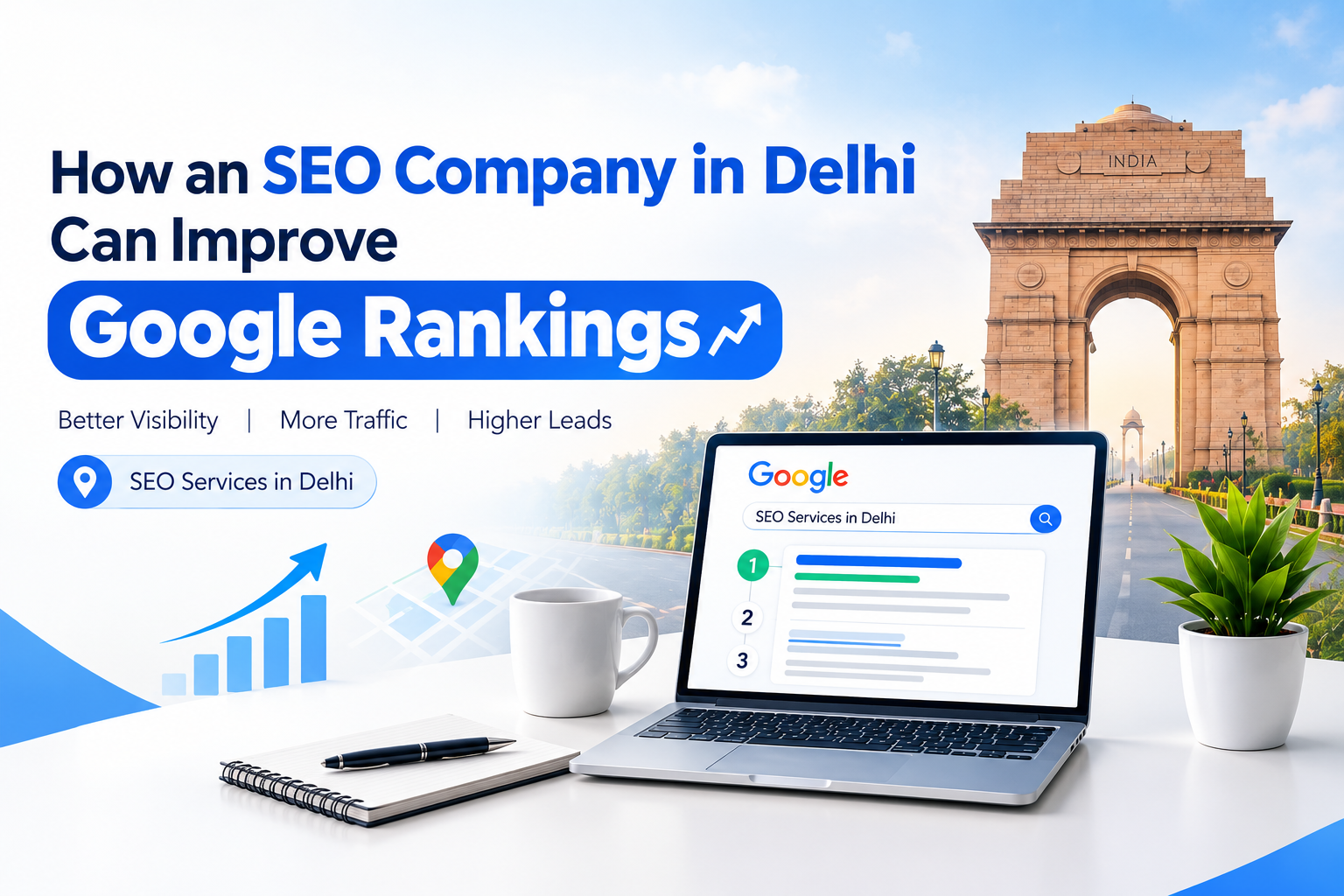
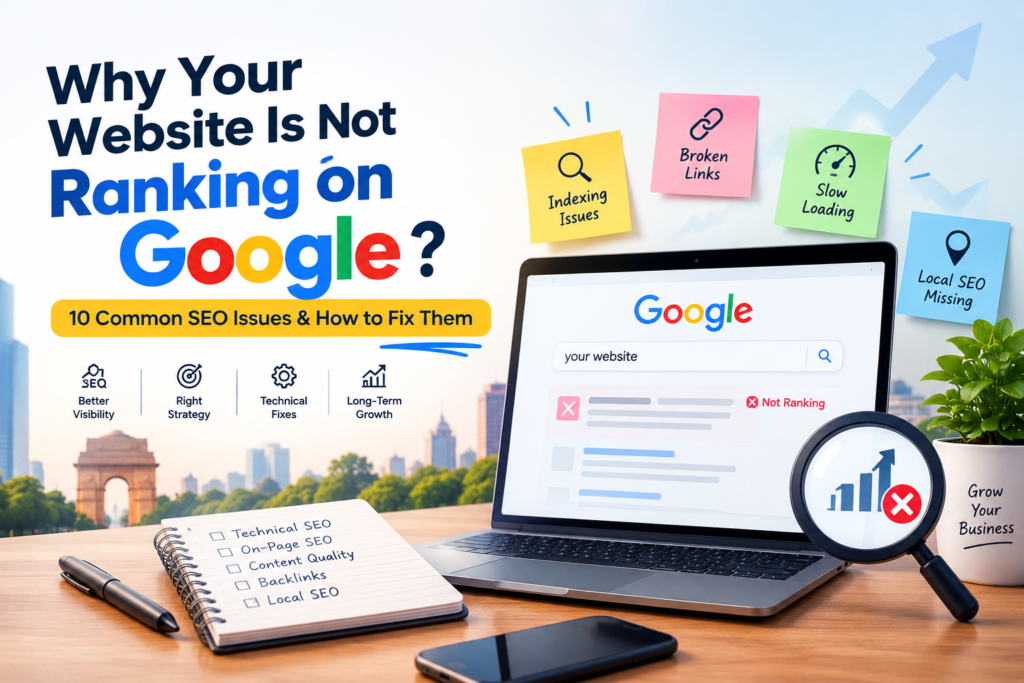
Is your website not ranking on Google? Discover 10 common SEO issues and practical solutions to improve visibility with SEO services in Delhi.
Why Your Website Is Not Ranking on Google: 10 Common SEO Issues
Having a website is important for any business today, but simply putting a website online does not mean it will automatically appear on Google.
Many businesses spend a lot of time creating their website, adding services and publishing content, yet their pages still struggle to appear in search results. If you are facing the same problem, there may be several reasons behind it.
Sometimes the issue is technical. In other cases, the website may be targeting the wrong keywords, have weak content, load slowly, or lack a proper internal linking structure. For businesses targeting customers in Delhi, local SEO can also play an important role.
This is where a structured SEO strategy becomes useful. Professional SEO services in Delhi can cover areas such as technical SEO, on-page optimization, keyword research, content optimization, local SEO and ongoing performance monitoring.
In this guide, we will look at 10 common SEO issues that can prevent your website from ranking well on Google and, more importantly, what you can do to improve them.
1. Your Website Is Not Properly Indexed
Before worrying about rankings, you first need to make sure Google can actually find and index your important pages.
If Google cannot crawl or index a page, that page has little chance of receiving organic search traffic.
There are several reasons why a page may not be indexed. For example, a `noindex` directive, incorrect robots.txt settings, access restrictions or technical problems can prevent Google from accessing a page.
Google Search Console is one of the first places you should check. Its URL Inspection tool can help you understand how Google sees a particular URL.
Here are a few things to check:
* Is the page indexed?
* Is it blocked by robots.txt?
* Does the page contain a noindex directive?
* Can Googlebot access the page?
* Is the correct canonical URL being used?
* Is the page returning a normal HTTP status code?
There is little point in spending hours building backlinks or writing new content if Google cannot properly access the pages you want to rank.
Start with indexing. Make sure your important pages are discoverable and accessible to search engines.
2. You Are Targeting the Wrong Keywords
Choosing keywords simply because they have a high search volume can be a mistake.
Your keywords should match what your potential customers are actually searching for and what your business provides.
For example, a digital marketing agency in Delhi might want to rank for a broad term such as “digital marketing.” However, a more specific search such as SEO services in Delhi” may have a much clearer connection to a particular service and location.
Good keyword research should consider:
* Search intent
* Relevance to your services
* Location
* Competition
* Business value
* Customer requirements
Search intent is particularly important.
Someone searching for “what is SEO” is probably looking for information. Someone searching for “SEO services in Delhi” may be looking for a company that provides SEO services.
These are two completely different types of searches.
Instead of forcing the same keyword into every paragraph, build content around the actual questions, problems and needs of your audience.
The goal is not to use a keyword as many times as possible. The goal is to make your page the most relevant answer to the search. 3. Your Content Does Not Provide Enough Value
Publishing blog posts regularly is not enough to improve your Google rankings.
If your content simply repeats information that readers can find on dozens of other websites, there may be little reason for users to choose your page.
Think about what your content actually offers.
Does it explain something clearly? Does it answer a real question? Does it provide examples? Does it give readers information they can use?
For example, instead of publishing another generic article about SEO, a Delhi-based business could create a more useful guide covering topics such as:
* Local SEO strategies
* Google Business Profile optimization
* Technical SEO checks
* Delhi-specific search behaviour
* Website conversion improvements
* Common SEO mistakes
* Practical examples
This type of content has a clearer purpose and can be more useful to the people you are trying to reach.
Google’s spam policies also warn against producing large amounts of unoriginal content primarily to manipulate search rankings.
So, rather than publishing hundreds of low-value articles, focus on creating fewer pieces that genuinely help your audience.
Your first priority should always be the reader.
4. Your On-Page SEO Needs Improvement
On-page SEO helps both search engines and visitors understand what a page is about.
A page should have a clear topic, logical structure and useful information.
Some of the important on-page elements include:
* Page title
* Main heading
* Subheadings
* Relevant content
* URL structure
* Internal links
* Image alt text
* Meta description
* Clear content structure
For example, if your page is targeting SEO services in Delhi, the content should clearly explain your SEO services, process, areas of expertise and the type of businesses you help.
Simply mentioning the keyword several times will not make the page more relevant.
Your title and headings should accurately describe the content. The copy should then naturally cover the subject in enough detail to answer the visitor’s questions.
Good on-page SEO is more about clarity and relevance than keyword repetition.
If a visitor lands on your page and immediately understands what you offer, who you help and why the page is relevant to them, your on-page structure is doing its job.
5. Your Website Has Technical SEO Problems
Technical SEO is the foundation of your website.
Even if you have excellent content, technical problems can make it difficult for search engines to crawl, understand or properly process your pages.
Some common technical SEO issues include:
* Broken links
* Incorrect redirects
* Duplicate URLs
* Incorrect canonical tags
* Crawlability problems
* Missing XML sitemap
* Incorrect robots.txt configuration
* Slow-loading pages
* Mobile usability issues
* Incorrect status codes
Canonicalization is another area that deserves attention, especially when your website contains similar or duplicate URLs.
Google uses multiple signals when selecting a canonical URL, and the URL selected by Google may not always be the same one specified by the website owner.
A technical SEO audit can help identify these problems before they affect more areas of the website.
For larger or more complicated websites, professional technical **SEO services in Delhi** can also help businesses identify and fix technical issues systematically.
6. Your Website Is Too Slow or Provides a Poor Page Experience
Nobody likes waiting for a website to load.
A slow website can frustrate visitors, especially when they are browsing from a mobile device or using a slower internet connection.
Google’s page experience guidance includes areas such as Core Web Vitals, mobile usability, secure browsing, intrusive interstitials and whether the main content is easy to identify.
However, there is an important point to remember: achieving a perfect PageSpeed score does not automatically guarantee higher Google rankings.
Core Web Vitals are useful performance measurements, but there is no single score that guarantees a top position in search results.
There are several practical ways to improve website performance:
* Compress large images
* Reduce unnecessary scripts
* Improve server response time
* Use effective caching
* Optimize videos
* Make pages responsive
* Remove unnecessary design elements
A faster website can also make the overall experience better for visitors who arrive through organic search.
So, website speed should be viewed as both an SEO consideration and a user-experience issue.
7. Your Website Is Not Optimized for Mobile
Open your website on your phone and actually use it.
Can you read the text comfortably? Are the buttons easy to tap? Does the navigation work properly?
A website can look perfectly fine on a desktop computer and still have problems on smartphones.
Since a large number of users browse websites through mobile devices, mobile optimization should be part of your overall SEO strategy.
Check that:
* Text is easy to read
* Buttons are easy to tap
* Navigation works correctly
* Images fit the screen
* Forms work properly
* Important information is easy to find
* Pop-ups do not cover important content
It is also worth testing your main pages on different screen sizes rather than checking only one phone.
Mobile optimization should not be something you think about after the website is finished. It should be considered throughout the design, development and SEO process.
8. Your Internal Linking Structure Is Weak
Internal links are links that connect one page of your website to another.
They may seem simple, but a good internal linking structure can make your website easier to navigate and help search engines understand how different pages are related.
For example, a blog about local SEO could naturally link to:
**Local SEO Services → SEO Services → Contact Page**
Similarly, an article discussing Google Ads could link to the relevant paid advertising service page.
When adding internal links, use descriptive anchor text so visitors have a clear idea of where the link will take them.
At the same time, avoid adding links everywhere just because you think more links will automatically improve SEO.
Every internal link should have a purpose.
Ask yourself:
Does this link help the visitor find something useful?
If the answer is yes, it is probably a meaningful internal link.
9. Your Local SEO Is Weak
If your business serves customers in a particular city, local SEO can be an important part of your online visibility.
For example, a business serving Delhi may want to appear when potential customers search for relevant services in Delhi or nearby areas.
Local SEO can include:
* Google Business Profile optimization
* Consistent business information
* Local keyword targeting
* Location-specific landing pages
* Relevant local content
* Customer reviews
* Local citations
* Internal links between service and location pages
For a Delhi-based company, **SEO services in Delhi** can be part of a broader local search strategy designed around relevant customer searches.
However, local SEO is not about creating dozens of pages where only the city name changes.
Those pages should provide genuinely useful, location-specific information.
The objective is to make it easy for both users and search engines to understand where your business operates and what services you provide.
10. Your Website Lacks Authority and Relevant Signals
Sometimes a website has technically sound pages and useful content but still faces strong competition.
In these situations, the website may need to build more relevance and authority within its industry.
This can involve:
* Publishing useful original content
* Building relationships within your industry
* Earning relevant mentions
* Promoting valuable resources
* Improving internal linking
* Creating original research or insights
* Building a recognizable business presence
Backlinks can also play a role, but quality matters more than simply collecting a large number of links.
Getting hundreds of unrelated or low-quality backlinks is not a sustainable SEO strategy.
Instead, focus on earning links and mentions that are relevant to your industry and provide genuine value.
Avoid link-building techniques that are designed purely to manipulate Google’s search results.
How to Find Out Why Your Website Is Not Ranking
If your website is not ranking, do not start changing everything at once.
A structured SEO audit can help you identify where the actual problem is.
### Step 1: Check Google Search Console
Start by reviewing your Search Console data.
Look at:
* Indexing status
* Search queries
* Clicks
* Impressions
* Average position
* Indexing issues
* Core Web Vitals
* Manual actions
* Security issues
This information can give you a much clearer picture of how Google is discovering and displaying your website.
Step 2: Check Your Important Pages
Create a list of your main service pages, landing pages and other important URLs.
Then ask:
* Are they indexed?
* Do they target a clear search intent?
* Are the titles descriptive?
* Is the content genuinely useful?
* Are they internally linked?
* Do they work properly on mobile?
This simple review can uncover problems that are easy to overlook.
Step 3: Check Technical SEO
Review important technical elements such as:
* Robots.txt
* XML sitemap
* Canonical tags
* Redirects
* Broken links
* HTTPS
* Page speed
* Mobile experience
Fixing technical problems can give your website a stronger foundation for future SEO work.
Step 4: Improve Existing Content
Look through your existing pages and identify content that is:
* Too short
* Outdated
* Repetitive
* Poorly structured
* Missing important information
* Targeting unclear search intent
Instead of simply adding more keywords, improve the actual usefulness of the page.
Add missing information, improve the structure, update outdated sections and make sure the content answers the questions your audience is asking.
Why Professional SEO Services Can Help
SEO is not one single task.
It involves several connected areas, including technical optimization, keyword research, content, local search, internal linking, website performance and ongoing monitoring.
For businesses that do not have an in-house SEO team, professional **SEO services in Delhi** can provide a more structured way to identify and work on these areas.
An SEO company may help with:
* SEO audits
* Keyword research
* On-page SEO
* Technical SEO
* Local SEO
* Content optimization
* Internal linking
* Website performance
* Search Console monitoring
* SEO reporting
The right strategy will depend on the website, industry, competition, target audience and business objectives.
There is no single SEO checklist that works exactly the same way for every business.
How Perkis Digital Can Help
Perkis Digital provides digital marketing solutions for businesses that want to improve their online visibility and generate opportunities through digital channels.
A practical SEO strategy can bring together technical optimization, keyword research, content development, on-page SEO, local SEO and ongoing performance monitoring.
For a Delhi-based business, the objective should not simply be to get more pages indexed or add more keywords to a website.
The bigger goal is to build a website that is technically accessible, relevant to the target audience, easy to use and genuinely useful.
That approach creates a stronger foundation for long-term organic search growth.
Conclusion
If your website is not ranking on Google, adding the same keyword repeatedly or publishing hundreds of low-quality articles is unlikely to solve the underlying problem.
Start with the basics.
Check whether Google can crawl and index your important pages. Review your keyword targeting and search intent. Look at your content, technical SEO, internal linking, mobile experience, website performance and local search presence.
Google’s guidance makes it clear that there is no single ranking factor or shortcut that guarantees a top position.
SEO involves multiple parts of a website working together.
For businesses competing in Delhi, a structured SEO strategy can help create a stronger foundation for organic search visibility.
Whether you manage SEO yourself, have an in-house team or work with professional SEO services in Delhi , focus on the fundamentals: a technically sound website, useful content, clear search intent, strong internal structure and a good experience for real users.
SEO is an ongoing process, not a one-time task. Regular audits, content updates, technical checks and performance monitoring can help you identify problems and make better improvements over time.